
How Does Sound Travel Through A Room?
Sound is also a form of energy, just like heat, electricity, and nuclear radiation. Sound energy starts as motion, which causes particles in the surrounding medium (usually air) to move and make the sounds we hear every day. Sound can travel through more than just air, though. Anyone who has ever lived in an apartment building or lived next to a busy street knows this. Noise from outside always travels through the walls and into our homes.
So how does sound travel through a room? And what can we do to prevent it from affecting our lives? This guide will cover the basic science behind sound. This can provide you with important soundproofing tips to keep your home quiet and peaceful.
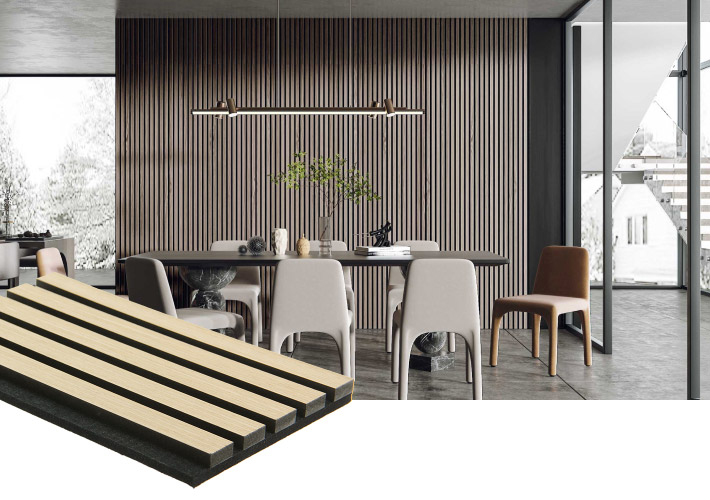
Low to No Maintenance Interior Acoustic Panels
In a world filled with noise, acoustic panels emerge as the elegant solution to create serene environments.
View MoreTable of Contents
Basics of Sound Waves
If you could see sound, it would look like waves moving back and forth from the source. Since sound waves are created by vibrations. So when someone beats a drum or yells, what you hear is actually a series of vibrations traveling to your ears.
When these sound waves hit our ear canal, they cause our eardrum to vibrate, which then affects our cochlea. The cochlea is the part of the ear that receives and understands sound. These sound signals are then sent through the cochlea to our brain. There they are interpreted and then provide us with relevant information.
The cochlea can understand sound based on the way the sound waves behave. This is what one hears as volume and pitch. However, in order to properly understand sound waves, we need to know 3 characteristics of it:
- Frequency: the number of times a sound wave passes a point in a given time is called frequency. The unit of measurement of Hertz (Hz) is based on the second, which is the most commonly used unit of time. 1 Hz equals one sound wave per second passing through a point.
- Wavelength: The distance from the highest point (crest) to the lowest point (trough) of a sound wave is known as the wavelength. As a distance measurement, it is usually measured in meters or feet. It records the distance that sound travels in an enclosed space.
- Amplitude: The distance from the center point of a sound wave to the crest or trough is called the amplitude. The farther a sound wave travels, the more energy it has (i.e., the louder it sounds). Like wavelength, amplitude is also measured in meters or feet.
How Sound Travels Through the Air
When you speak, clap, or make any other sound, you disturb the empty silence. The vibrations of your hands or vocal cords cause the pressure of the air around you to change. These fluctuations spread in all directions at the same time, right? They then disturb the air particles around them, thus producing the sound we hear.
The speed at which sound travels through the air affects how high or low we hear it. The shorter and faster the sound wave travels, the higher the frequency of the sound. The longer and slower the sound wave, the lower the frequency.
Listed below are several factors that can affect the speed of sound:
- The temperature of the environment
- The density of the surrounding air
- The path the sound must take and what blocks it
How Sound Reacts with Room Surfaces
There are many factors that can affect how sound interacts with different surfaces in a room, for example:
- The frequency of the sound
- The size or amplitude of the sound wave
- The hardness and density of the objects that the sound encounters
Sound waves can interact with any object in four different ways. Regardless of its material or the size of the sound.
- Reflection: Sound waves bounce back when they hit a hard surface such as a wall or floor. Echo occurs when sound is reflected many times in a closed room of appropriate size.
- Absorption: Dense, thick, and porous materials tend to absorb sound rather than reflect it. Therefore, if you don’t want to create echoes, you must line your walls with materials that reduce and absorb sound.
- Diffusion: Diffusion is the spreading of sound evenly over an area to reduce its energy and amplitude. Diffusers help to break up sound waves and change the direction in which sound travels, thus avoiding excessive sound buildup.
- Propagation: This is when sound travels through floors, walls, and ceilings to reach other places. This usually occurs when surfaces are not dense enough to absorb, reflect, or block sound.

Room Acoustics and Sound Behavior
When it comes to sound, a small, empty room works better than a large room filled with furniture and other heavy objects. On the other hand, the larger the room, the more space there is for sound to move between the walls. This also means more echoes.
The longer the distance sound moves between reflections, the more likely it is to echo and reverberate. This is why you can be heard in unoccupied valleys and mountains. But you may not be heard in a forest.
The same reasoning can be used in a room. If the sound wave has to travel a longer distance before it is reflected and hits more things along the way. Then the energy of the sound wave is reduced. This means that echoes and reverberations will occur less frequently.
In addition, the shape of the room also affects the propagation of sound. This is because the more bounceable surfaces there are, the more chances there are for sound to be reflected. And, of course, more obstacles are better at dissipating the energy of sound waves.
Practical Applications and Soundproofing Tips
So how can all this science help you improve the sound quality of your room and stop sound from traveling to other rooms? There are many products that can improve the sound absorption of a room or make it completely soundproof. Which soundproofing method you need to use depends on where you work:
Recording studios
In order to completely soundproof a recording studio, you need to install acoustic clips. Acoustic clips separate the room from the rest of the building and stop vibration noise from spreading. To reduce echoes, you should also cover all walls with sound-absorbing material such as acoustic panels. Finally, you should install a heavy, secure door to keep noise out of the room. This is because the gaps around the door are one of the ways in which noise can travel.
Home Theater
For the best viewing experience, a home theater should have good acoustics. In addition, it should have proper lighting and aesthetically pleasing décor. Good acoustics can be obtained by installing COOWIN acoustic wall panels. COOWIN’s acoustic wall panels have a wide range of options to decorate your home theater well.

Other Rooms
You can soundproof almost any room or improve its sound quality. Whether it’s a bedroom, living room or kitchen. To stop noise from traveling from one room to another, you can separate the rooms with soundproofing clips. Then line the walls with suitable acoustic panels and seal any cracks and holes with acoustic sealant.
Cautions
As mentioned earlier, temperature and air density affect the distance and speed at which sound travels. Sound travels faster when the air is hot and thick, such as in the tropics.
The sound of a room is also affected by its architecture. This is why concert halls are built to be great places for musical performances. Professionally built auditoriums come in only a few basic shapes. However, recent studies have shown that the standard rectangular space produces the greatest dynamic range of all styles.
Contact Us
Sound is a form of energy that travels in waves through objects such as air and walls. Dense, hollow materials tend to absorb sound. Solid, hard surfaces, on the other hand, tend to reflect sound. You can use a variety of materials to change and improve the sound in your home, office, or elsewhere. This can make them sound better and separate them from other areas.
COOWIN has everything you need to soundproof your premises and improve the sound quality. You can reduce the noise in a room by using a wide range of soundproofing materials. In addition, you don’t need to give up the aesthetics of a room in order to improve its acoustics. Because COOWIN’s acoustic panels can decorate your room very well.
Related Post
Share

Latest blog

Do I Need to Cover the Entire Wall with Acoustic Panels?
April 8, 2025


The Basics of Acoustic Panels for an Auditorium
April 2, 2025